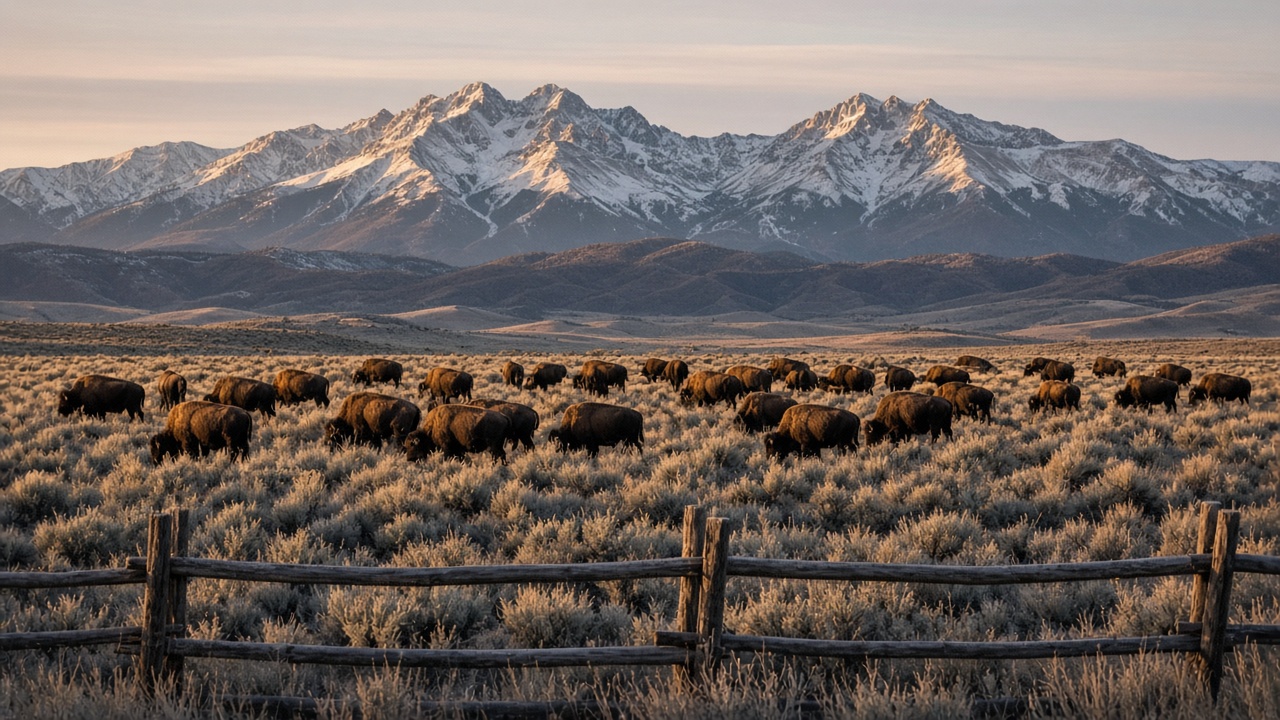
Start with the name. To Lewis and Clark, the shaggy herds along the Missouri were buffalo; the scientists’ Latin bison caught on later, just as the animal came close to vanishing. That’s the opening of Tate Watkins’s Cross Country column on the Journal’s op-ed page this weekend, and he follows it with a fighting claim: the people who brought the animal back mostly weren’t in Washington. They were ranchers, and the biggest one was Ted Turner.
Turner, the cable-TV pioneer, died in May at 87 with about 45,000 head — no private herd anywhere is bigger, and it works out to about one U.S. bison in five. When he started buying, in the late 1970s, North America may have had only 30,000 left. Watkins, a research fellow at the Property and Environment Research Center, reaches further back: commercial hide hunters shot the species down to perhaps 1,000 animals by the late 1880s, Yellowstone’s herd was poached from 200 to two dozen under federal supervision, and privately bred herds supplied the animals that restocked the continent. Government today oversees some 20,000 bison, fewer than 1 in 10, about where it stood a century ago, he writes.
Eat it to save it
What grew the herd, in his telling, was demand. Turner opened Ted’s Montana Grill in 2002 and put bison on menus in more than a dozen states, and Time summed up the logic: “Sometimes you have to eat an animal to save it.” Private ranches now hold about 80% of a U.S. herd of roughly a quarter million. Only 80,000 are harvested a year, prices sit at records, often nearly double beef, and the population is up about tenfold in 50 years. His modern example is Matt and Sarah Skoglund, who started North Bridger Bison from scratch in 2018, about 40 minutes north of Bozeman. Their roughly 250 head graze land the couple put under a permanent conservation easement, and they sell the meat straight to customers. Skoglund, who spent a decade on bison policy at an environmental group, decided conservation “has to happen through how we produce things and how we consume things.”
Our read
We’ll leave the public-versus-private fight to Watkins and his critics. The planning point is that line about the easement. A conservation easement is an Estate and Tax tool hiding in plain sight for anyone who owns land they love: the family keeps title and can keep ranching or farming, while a land trust or agency holds a permanent limit on development. Donated and properly documented, it can bring an income-tax deduction, and because the development rights are gone, it usually lowers the land’s value for estate-tax purposes — which can make it easier for the next generation to keep the place rather than sell it to pay the bill.
The fine print is real. Permanent means every future owner is bound, your children included, and the appraisal behind the deduction has to hold up; the IRS has spent years going after syndicated easement deals sold mainly on the size of the write-off. Watkins’s other point travels, too: his ranchers protect bison because bison pay, and an incentive tends to outlast a sermon. If land is part of your legacy, decide what it’s for while you still hold the pen — fences are easier to mend before the storm.