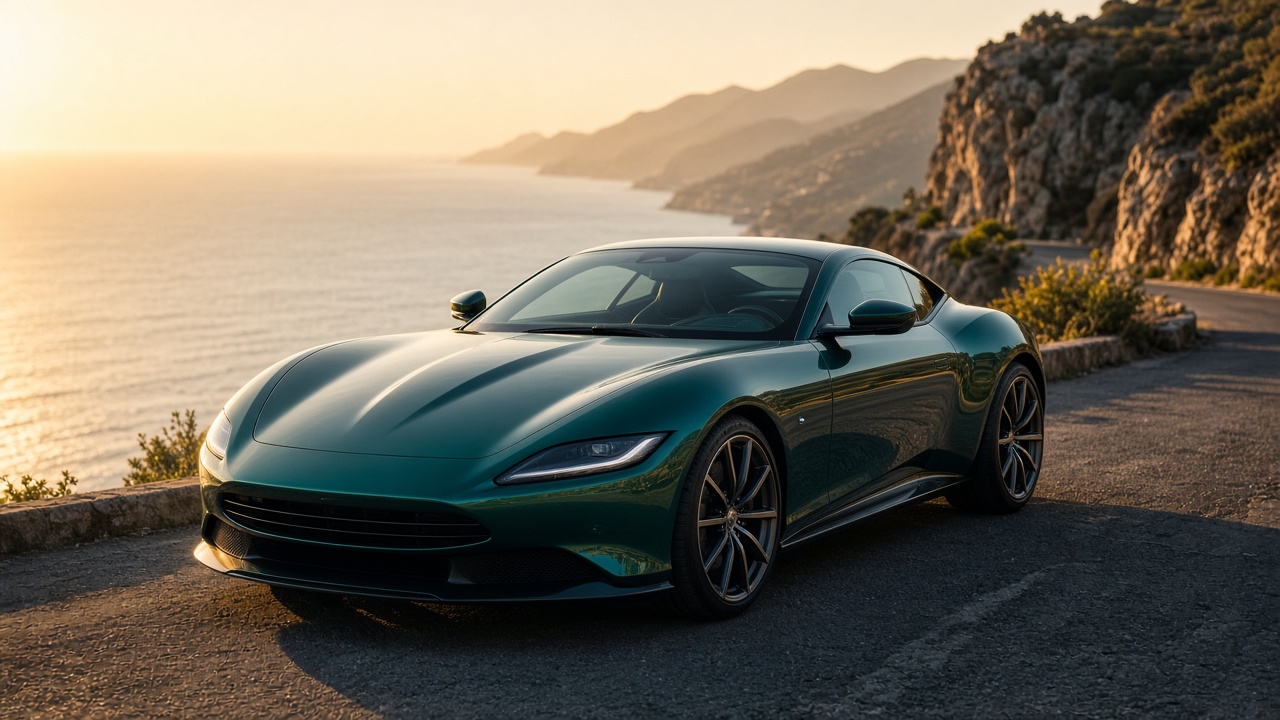
Every carmaker has an entry-level model. Ferrari (RACE) has one too, and it starts at $261,810. That’s the 2027 Amalfi, a mid-front-engined GT with two seats and a little bench in back for kids, and Dan Neil — reviewing it in this weekend’s Rumble Seat — would take it over anything else in the showroom. Read the fine print, though: that number is before options and delivery. The teal-green car Neil drove arrived with $143,710 of personalization, which is more than half the base price, spent on a car that’s supposed to be the sensible one.
His case for the cheap seat is mostly about looks. Climb the ladder and Ferrari’s series-production cars — the 12Cilindri GT, the Purosangue SUV, the all-electric Luce — start between $400,000 and $600,000. Above those sits the Icona tier (Daytona SP3, F80), where, Neil notes, the taxes alone would run past what his test car cost. His complaint is that the styling gets louder as the price climbs — he rates it in a unit of his own invention, per cubic foot, whose name we’ll leave in the Journal. He’d buy the Amalfi and give the rest to charity.
It’s no consolation prize. The twin-turbo 3.9-liter V8 makes 631 hp at 7,500 rpm, Ferrari quotes 0–62 mph in 3.3 seconds, and the turbos can spin to 171,000 rpm. Neil’s gripes are the kind owners dream of having: stop-start that re-arms itself every time you fire the car up, an exhaust muffled by noise rules, a passenger screen for admiring g-loads, and a gear selector that makes you tick the right paddle to find first. He tested it during Monterey Car Week, the one place a new Ferrari goes unnoticed — unlike, he points out, the Chick-fil-A drive-through back home in Raleigh.
The base price is the bait
Line up the numbers: $261,810 to start, $143,710 of personalization, and $430,796 on the as-tested line of the spec box. Neil doesn’t walk through every dollar between the first figure and the last, and we won’t guess. The direction is the lesson. The car in the ad and the car in the driveway are two different purchases, and only one of them has the right price on it.
Our read
This is cash flow (M5), and it isn’t really about Ferraris. Big purchases — a car, a kitchen, a boat, a lake house — get marketed off the base price, and the base price is rarely what anyone pays. Then come the costs no window sticker shows: sales tax (and, in many states, registration fees) that scale with the price, insurance that scales with value and horsepower, upkeep, and depreciation, which on most new cars is the biggest cost of all. Neil’s aside about Icona taxes says it in one breath: at a high enough price, the side costs become a car.
The planning move is to decide the all-in number first — the options you’ll actually tick, plus a few years of carrying costs — and to pay for it from money that isn’t already doing another job. A dream purchase should fit inside the plan, not rewrite it. Neil’s own pick is a decent template: the least expensive car in the lineup, and the coupe over the convertible Spider because it’s more practical (he’s only half kidding). If something big is on your horizon, run the full number with us first; it’s easier to check the forecast before you order the convertible.