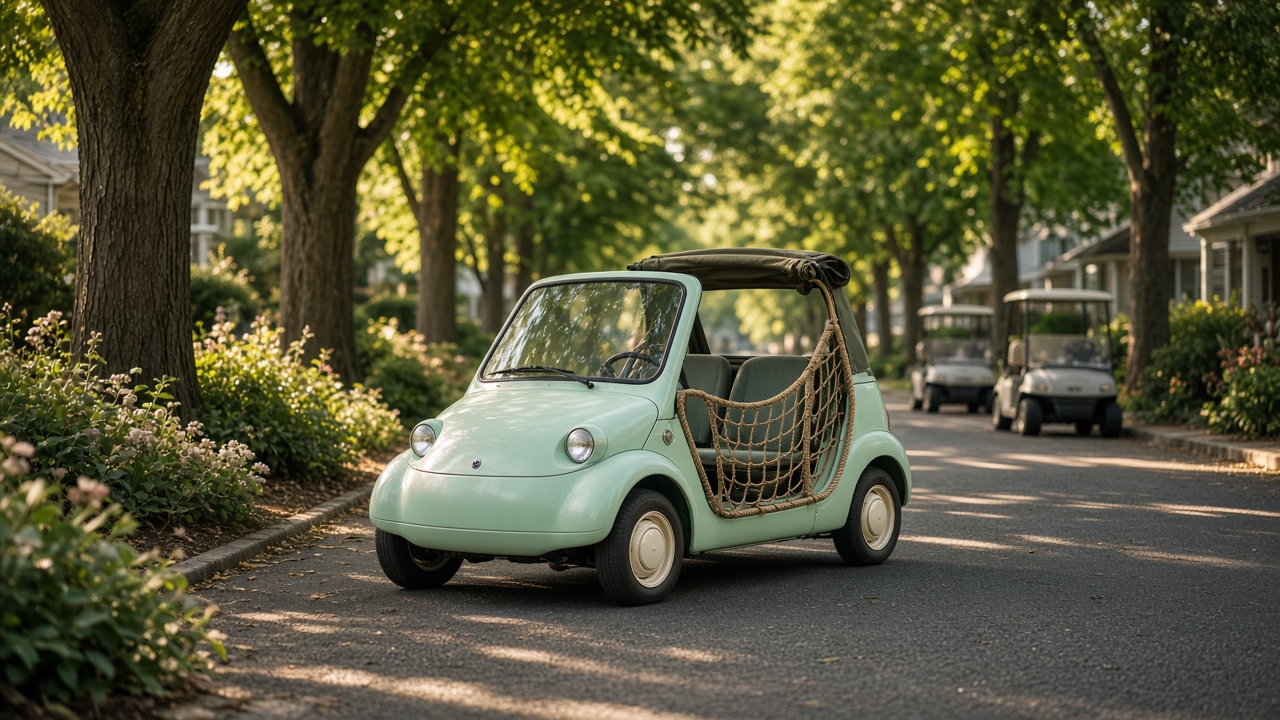
“Is that a real car?” a student asked the Journal’s Ryan Felton, who spent several days puttering around his hometown of Ann Arbor, Mich., in a mint-green Fiat Topolino with ropes where the doors should be. It is a real car. It’s also electric, street-legal, $15,000 and engineered not to go faster than 25 miles an hour — which is how a man running errands becomes the most photographed thing in a college town.
Topolino means little mouse, and the name fits. The two-seater weighs just over 1,000 pounds, runs 46 miles on a charge and comes in exactly one color. Felton’s front-page piece frames it as Fiat’s wager that families who already own two cars would happily make the second one tiny and slow. So far the bet’s paying: Fiat sent 300 to start, and 30% of its U.S. dealers have signed on. The test drive had its comedown, though. Heading home from Trader Joe’s on a 35 mph main drag with the pedal mashed, Felton watched car after car swing around him in the turn lane and felt guilty — 25 versus 35 turns out to be a big gap. A pharmacy drive-through attendant who cracked up at the sight of the little car made him feel better.
The golf-cart crowd gets it
The best clue to who this car is for came from a dealer near St. Louis who ordered several. Fiat asked why. The answer: a retirement community of Italian immigrants, many of them golf-cart drivers, wanted them. Next to a golf cart, the Topolino is plush: seat belts, headlamps, a windshield, a heater if you skip the ropes. Next to a real car, it’s another animal. Low-speed vehicles don’t come with air bags and don’t have to pass structural crash tests, and Felton — who bikes in traffic — found the plastic body panels very much on his mind at top speed. Jim Summers, 58, who owns an e-bike shop in town, had Michigan’s first Topolino delivered on a flatbed. He already drives a Tesla Model 3 and runs his house on solar. Why the mouse? “I hate driving in town,” he said.
Our read
Two planning lessons ride in this little car. The first is Cash Flow (M5): a second vehicle is a recurring bill, not a one-time purchase — insurance, registration, charging, tires and the slow leak of depreciation. In retirement, once the paycheck stops, that line matters more than the sticker. For a couple down to one commute, the honest question isn’t which second car to buy but whether the errands need a full-size second car at all. A $15,000 runabout that replaces a second sedan can free up cash. One that replaces a golf cart is an upgrade you’ll pay for every year. One that simply joins two big cars in the driveway is a third car.
The second is Insurance and Consumer Protection (M11). No air bags and no crash-test requirement mean your own coverage does more of the protecting. Before you buy, ask your agent how a low-speed vehicle is classified and covered, check your medical-payments and uninsured-motorist limits, and consider an umbrella policy if your liability limits are thin. Learn which roads your state allows, too; that 35 mph stretch is where the guilt and the risk both live. As for Stellantis (STLA) — $4.40 at Friday’s close and down 59.6% this year — one charming mouse doesn’t change the picture. It isn’t owned in any model book; we watch. And read the policy before the test drive — it’s easier to find the umbrella while the sky’s still blue.