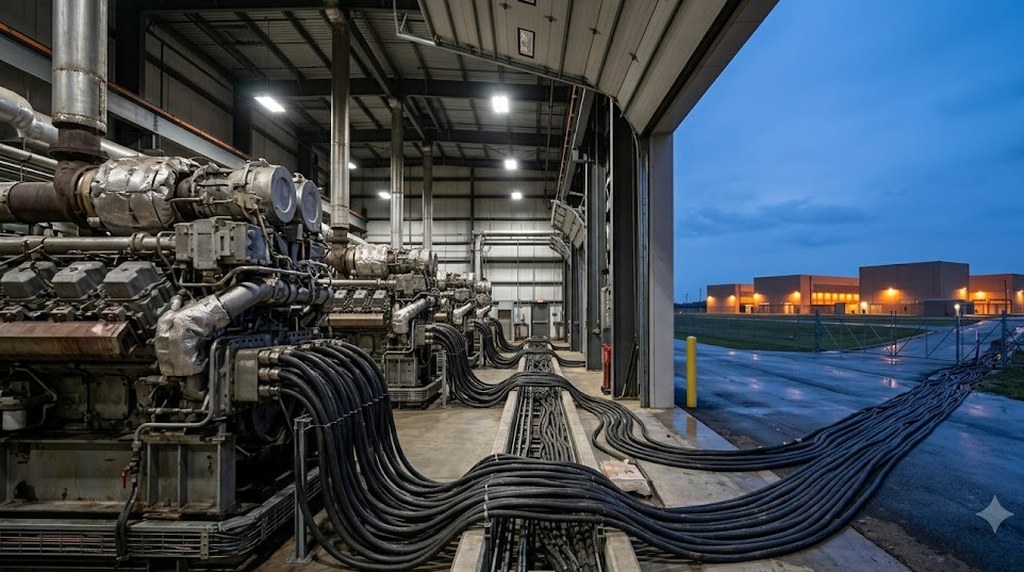
Google needs more power in Wyoming. American Electric Power (AEP) will build the company a plant of its own. AEP said Wednesday, Oct. 14 that it plans to spend about $4 billion on a fuel-cell project near Cheyenne. Google will buy the power under a 20-year contract. Construction starts this year.
The plant belongs to Cheyenne Fuel Cell, which AEP owns about 92% of. It uses fuel cells from Bloom Energy (BE), a design built to go up fast and run on demand. AEP expects it to be fully running by the end of 2028. Chief executive Bill Fehrman said the project serves customers “both within and beyond our traditional service territory.” That last phrase is the story. A regulated utility is now selling power to one customer outside its home turf. Bloom's stock fell $24.11 to $239.34 on Wednesday, the day of the announcement.
Friday's paper carried a bigger version of the same idea. Venture Global, a natural-gas exporter, said it will build gas-fired power plants at its own sites to run data centers. It signed deals with GE Vernova (GEV) and Baker Hughes for turbines and transformers, both in high demand. Over time the plan could support up to 10 gigawatts of computing. None of it connects to the grid. Power could be ready in late 2028 or early 2029. Chief executive Michael Sabel called it “very copy-paste for what we've already been doing for years.” The company already runs its own off-grid plants at its gas export terminals.
A third of new data centers bring their own power
Developers of about one-third of all the data-center capacity now in the works plan to build power on site, by data provider Cleanview. The AI race has jammed the line to connect to the grid, the Journal reports. Building your own power is faster, though harder, and the AI companies have the money. So the buyers are tech firms, and the sellers are utilities, gas exporters and the turbine makers.
Our read
This is Investments/Risk · IN04. The desk holds the build-out at weight and added nothing this week. GE Vernova is in 30 books, Alphabet (GOOGL) in 28, Vistra (VST) in 15, Constellation (CEG) in 9, AEP in 5 and Bloom Energy in one. Venture Global isn't Cheniere (LNG), which we hold in 20 books. Venture Global isn't held. We put this story on watch for one reason. A 20-year contract is a fine business if the customer is still there in year 12. The AI buyers are rich today. A utility that builds for one customer takes on that customer's risk, and the market is sorting these deals one at a time.
Your plan touches this in the income sleeve, the utility fund or stock you own for the dividend. Utilities used to be the quiet line in a retirement account. Now one is spending $4 billion to serve Google. This week, pull up your utility fund's top holdings and the dividend it pays. Then decide whether you own it for the check every quarter or for the AI build. Those are two different holdings with two different right sizes. Nobody waits for the lights to flicker to look at the fuse box. If the answer has drifted, that's a 20-minute talk we'd be glad to have in a review.