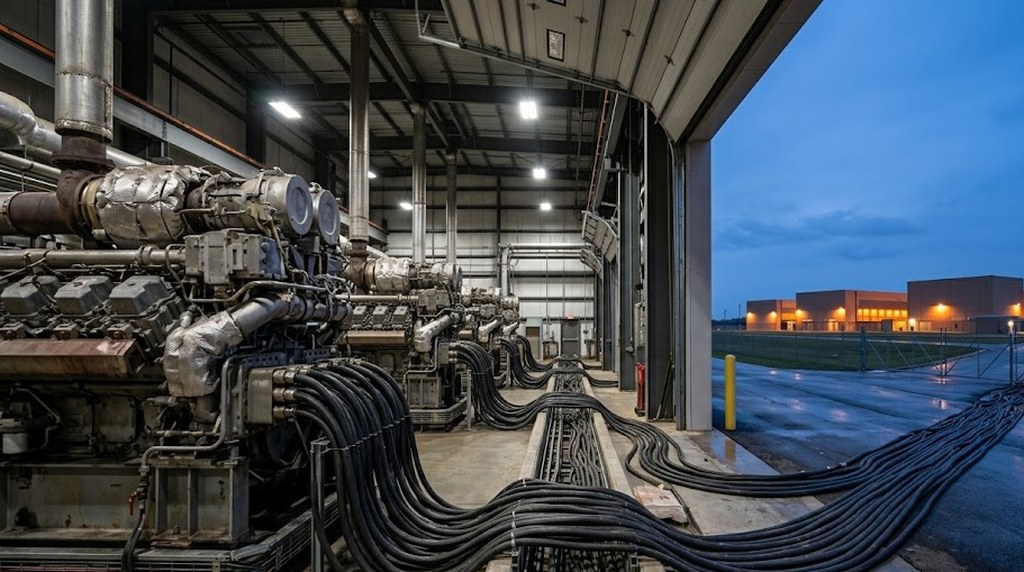
Caterpillar can't make turbines fast enough. The company told Wall Street on Thursday, Oct. 29, that it's taking orders for turbines into 2030 and for big engines into 2029. Its backlog hit a record $78 billion, nearly double a year ago. The stock fell 9.3% anyway.
Here's why. Third-quarter revenue grew 17% to $20.68 billion. Analysts wanted more. Growth had been 24% the quarter before, so this looked like a slowdown. Power and energy is the unit that sells generators and turbines to data centers. Its sales rose 18% to $8.78 billion. Construction equipment also grew 18%, to $7.98 billion. Mining equipment grew 15%, to $4.62 billion. Profit beat forecasts. Adjusted earnings, which leave out one-time items, were $7.20 a share against the $7.06 analysts expected. CEO Joe Creed said new factory capacity is "still the top pacing factor for growth in power and energy." In plain words, the limit is how fast they can build, not how much people want.
The power build-out is wider than turbines
The papers have two more pieces of the same story. The first is grid batteries. An industry group, the U.S. Energy Storage Coalition, says U.S. battery storage could hit one terawatt-hour by 2032. That's four times today's level. It would be enough to run Texas, California, Florida and Michigan at peak demand for four hours. A late-August order from President Trump bars new Chinese batteries from the U.S. grid. Korean and Japanese makers are filling the gap. At a DTE Energy site in Trenton, Mich., LG Energy Solution batteries can deliver 220 megawatts at once. That's enough for nearly 40,000 homes. In September, Nvidia (NVDA) approved LG Energy, Hitachi Energy and Tesla (TSLA) to supply batteries for AI data centers.
The second is permitting. Thursday's Journal editorial page described a draft Senate deal that could get a vote in the weeks after the election. It would bar federal agencies from canceling or suspending permits already granted. It would give people 150 days to sue over a permit and put a clock on environmental reviews. It would also let the Federal Energy Regulatory Commission approve transmission lines over state objections. Supporters say builders need that certainty. Critics, including a former Biden climate adviser, say courts couldn't undo a permit even if it was granted illegally. Nothing has passed. We'll report it if it comes up for a vote.
Our read
Investments/Risk · IN04. The build-out is real. The orders are real. The stock still fell, because sales growth came in under what Wall Street wanted. We think the price had already counted on the good news. That's the trap with the industrials swept into the AI trade. The business can be sold out and the stock can still go down. Caterpillar (CAT) is held at weight in 10 books; nothing added. Our power slice is GE Vernova (GEV) in 30 books, Vistra (VST) in 17 and NextEra (NEE) in 21, all held at weight with nothing added. On Thursday GEV rose $9.82 to $887.85 and NEE rose $1.12 to $82.14. VST fell $1.77 to $140.95. Same story, three different moves.
If you own a utility, infrastructure or AI-themed fund, open its holdings list this week. Find the power builders, the companies that make turbines, generators and grid gear. See how big a share of the fund they are now. A sold-out factory is a fact. A stock price is a guess about how long the factory stays sold out. Know which one you're paying for. The roof gets checked before the rain, not during it.