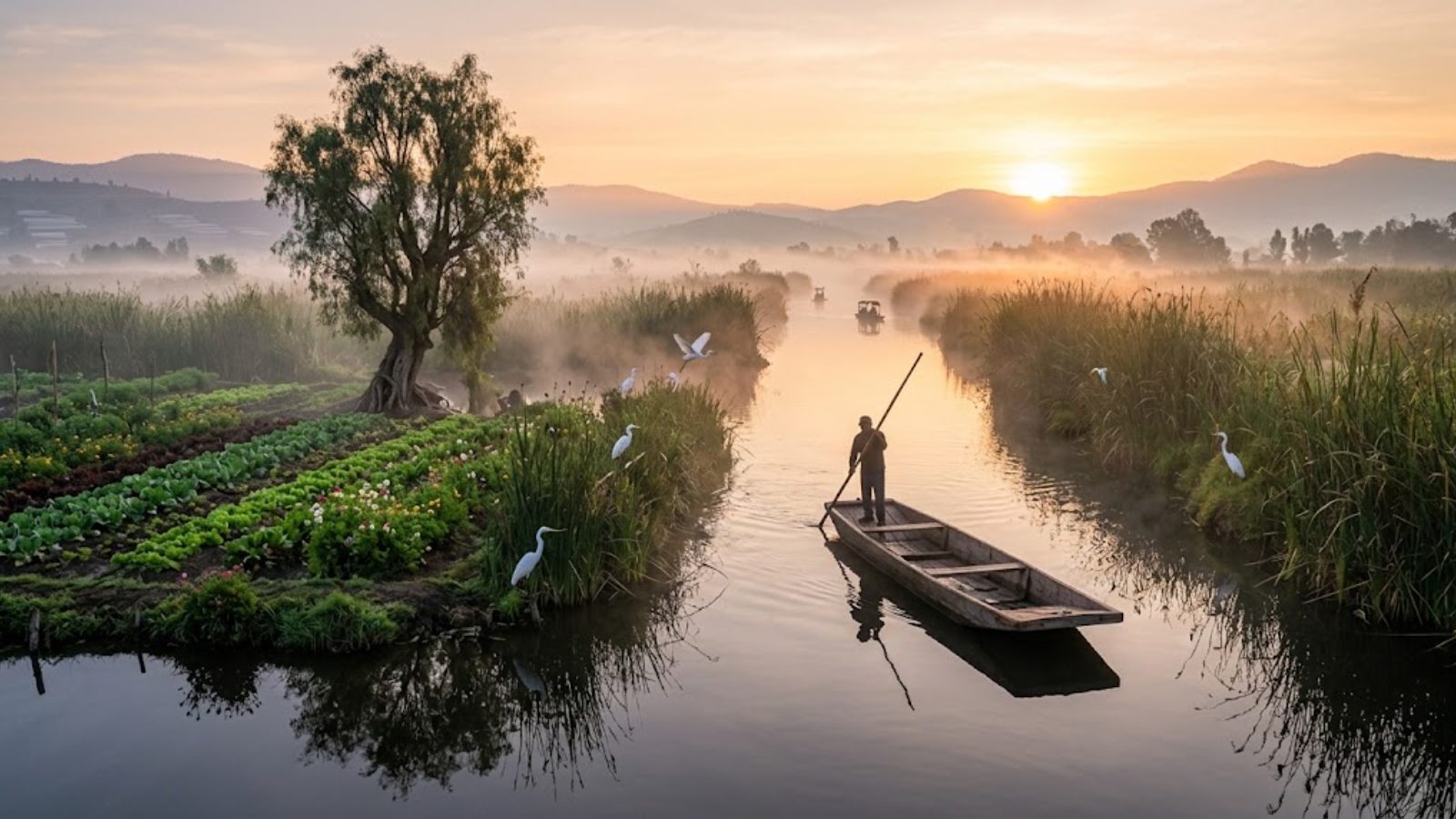
The full moon was approaching when Tony Perrottet was invited on a day trip to commune with the Aztecs. “Bring shorts and a towel,” his host said. Five hundred years ago the Aztec empire ran from an island capital, Tenochtitlan, in a system of five lakes in the Valley of Mexico. Temples, markets and pyramids were linked by canals and causeways, and at its peak some 200,000 people lived there. After Hernán Cortés took the city in 1521, the Spanish leveled the monuments, drained the lakes and filled the canals. Picturing the golden age today takes some help.
The lake that survived
One lake, Xochimilco, is still there, about an hour’s taxi south of the center. Perrottet boarded a rustic barge with a dozen young locals and was poled into a pre-Hispanic world: reeds and water lilies against the hull, willow branches overhead, white herons over dark water. He stepped onto a chinampa, one of the farmed terraces built from layers of mud and vegetation that have fed the city since Aztec days. The farm, Fuego Vivo, belongs to a young architect, Fernando Arozarena, who bought it three years ago and runs it as a cultural project with bamboo huts, dawn trips, organic lunches and tamale classes. “Xochimilco is the last living vestige of the Aztec era,” he says. The terraces made the Aztecs self-sufficient in food, “allowing them to create their empire.”
The shorts and towel were for a temazcalli, a sweat lodge whose traditions also date to the Aztecs. Perrottet crawled into a dirt-floored dome of sticks and blankets, sat cross-legged as red-hot volcanic stones were laid in a pit, and sweated in pitch dark while a friend of his host poured water on the rocks and chanted. Lunch afterward was squash tamales, beans and maize tortillas, a meal that could have been served seven centuries ago.
The city under the city
Tenochtitlan had not disappeared, he realized. It was under the pedestrians’ feet. In 1978 two electricity workers near the Zócalo unearthed an 8-ton stone disc carved with the moon goddess Coyolxauhqui. The great plaza, dominated by the Metropolitan Cathedral, had been the Aztecs’ sacred precinct, and the base of the Templo Mayor, the step pyramid with altars to the gods of war and rain, is now an open-air archaeological site. Its museum shows the Aztecs’ engineering, herbal medicine, astronomy, sculpture, ceramics and jewelry. They had a passion for flowers, doused themselves in perfume, wrote epic poetry and painted frescoes. “Their lives weren’t just about human sacrifices and war,” says Eric Márquez, a veteran guide for the national anthropology institute.
| Where | What is there |
|---|---|
| Xochimilco | Barges, chinampa farms, dawn trips and tamale classes at Fuego Vivo |
| Templo Mayor, by the Zócalo | The excavated pyramid base and its museum |
| Guatemala Street | A temple platform under the Catedral Hotel’s foyer; a ballgame court under its breakfast room; the Calmécac school for nobles under the Spanish Cultural Center |
| National Palace and Chapultepec | Rivera’s “History of Mexico” mural and his 100-foot tiled Tláloc lying in a pool |
| Anahuacalli | Rivera and Kahlo’s 60,000-piece collection in a museum of dark volcanic rock |
| Rosetta, Roma Norte | Chicatana-ant butter and tagliolini with escamoles, the ant larvae the Aztecs prized |
Why it persisted
The conquistadors tried to erase the language and the traditions. It did not work. A strand of Nahuatl is still spoken by more than a million people in rural villages, and the cultural revival began in the 1920s with Diego Rivera and Frida Kahlo. Rivera’s “The History of Mexico,” painted in the National Palace between 1929 and 1935, gives a bird’s-eye view of Tenochtitlan at its height. His Anahuacalli, built in the 1940s from volcanic rock to hold the couple’s 60,000 pre-Hispanic pieces, is one of the world’s strangest museums. The artist Betsabeé Romero presses gilded Aztec symbols into recycled car tires and serves visitors roasted grasshoppers. “The Aztec culture pervades Mexico City’s daily life today in a thousand subtle ways,” she says.
For a client, the practical read is this: Mexico City is a short flight, the dollar goes far, the food is among the best in the world and the history is deeper than anything in Europe at a third of the airfare. It is the winter trip to take before the summer one to Genoa.