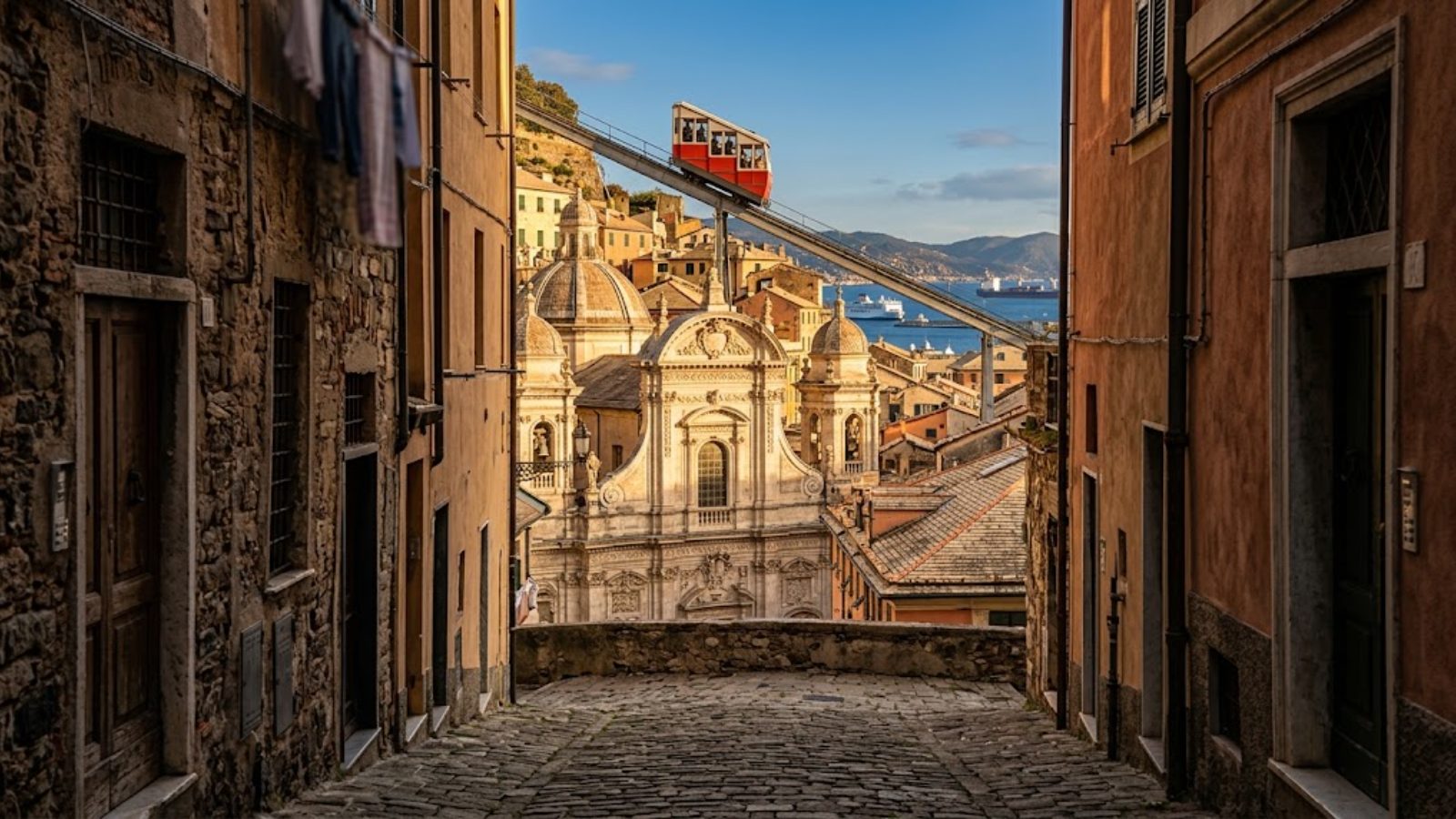
Genoa was a medieval rival to Venice and, for a few decades around 1620, the financial capital of early modern Europe. Eighteenth-century aristocrats made it a required stop on the Grand Tour. Then came a long postindustrial decline, and now, J.S. Marcus writes, the northwest Italian harbor city is a magnet again, full of surprises and an eccentric charm that rewards exploration.
The city that goes sideways
The elevation from the waterfront to Genoa’s hinterland approaches 6,000 feet, and neighboring districts can sit several hundred feet apart. So the city built a transit system that would be at home in an amusement park: horizontal elevators and funiculars that tunnel through buildings. The Castello d’Albertis-Montegalletto line is called an elevator, but its little cabins are part funicular, part cable car, part outdoor lift, and they climb about 250 feet in a ten-minute trip that goes backward and forward as well as up. It runs from the Piazza Principe train station to D’Albertis Castle, a 19th-century sea captain’s house that is now a museum, with a view of all of historic Genoa and the modern harbor.
Why the art is so good and the lines so short
Around 1620 Genoa’s patrician-merchant class, a few dozen families, made the Genoese Republic the monetary masters of Spain’s overseas empire and turned the city into one of modern capitalism’s first financial hubs. Those families became patrons to Rubens, Van Dyck and Genoa’s own Baroque master Bernardo Strozzi. Van Dyck’s portraits of Genoese nobles from the 1620s hang in the Palazzo Rosso; Rubens’s early 17th-century altarpiece is in the Church of the Gesù; the 12th-century Church of San Luca, rebuilt by the Spinola family, is plain outside and a whirlwind of Baroque inside. That contrast, restrained facade and secret extravagance, is the Genoese mentality, says Renzo Piano, the Pritzker-winning architect who splits his time between his native city and Paris.
| See | Why |
|---|---|
| Strada Nuova (Via Garibaldi) | Renaissance facades hiding Baroque and Rococo interiors; Palazzo Spinola Clavarino opens its main floor for Rolli Days this fall |
| Galata Maritime Museum | Columbus, born here in 1451, and a full reconstruction of the galley that built the Republic’s power |
| Aquarium of Genoa | 400 species; €38, about a month of breakfast focaccia |
| Antico Forno Patrone | Focaccia, salty and oily, eaten within hours of baking and dipped in cappuccino by locals |
Humble food, complex taste
Pesto here is basil, Ligurian olive oil, pine nuts, garlic and cheese ground to a paste and eaten with trenette or trofie, thinned with pasta water until everything turns bright green. Local food writer Enrica Monzani says pesto, which passes for gourmet elsewhere, was originally “a peasant trick to increase portions without spending too much money.” Focaccia has been made here since the Middle Ages, and the local habit is to dip it in cappuccino: “The saltiness of the focaccia combines with the bittersweetness of cappuccino, and the experience is amazing.” Pànera, a coffee semifreddo, is the one indulgence.
Genoa still has no connection to Italy’s main high-speed rail corridor, which is the reason it feels like terra incognita and the reason the museums are empty. For a client tired of the Florence lines, that is the whole recommendation. And for anyone in our business, there is a small lesson in the dates: a city was the world’s banker in 1620 and a backwater by 1820. No financial capital keeps the title forever, which is why we own the whole market and not the current champion.