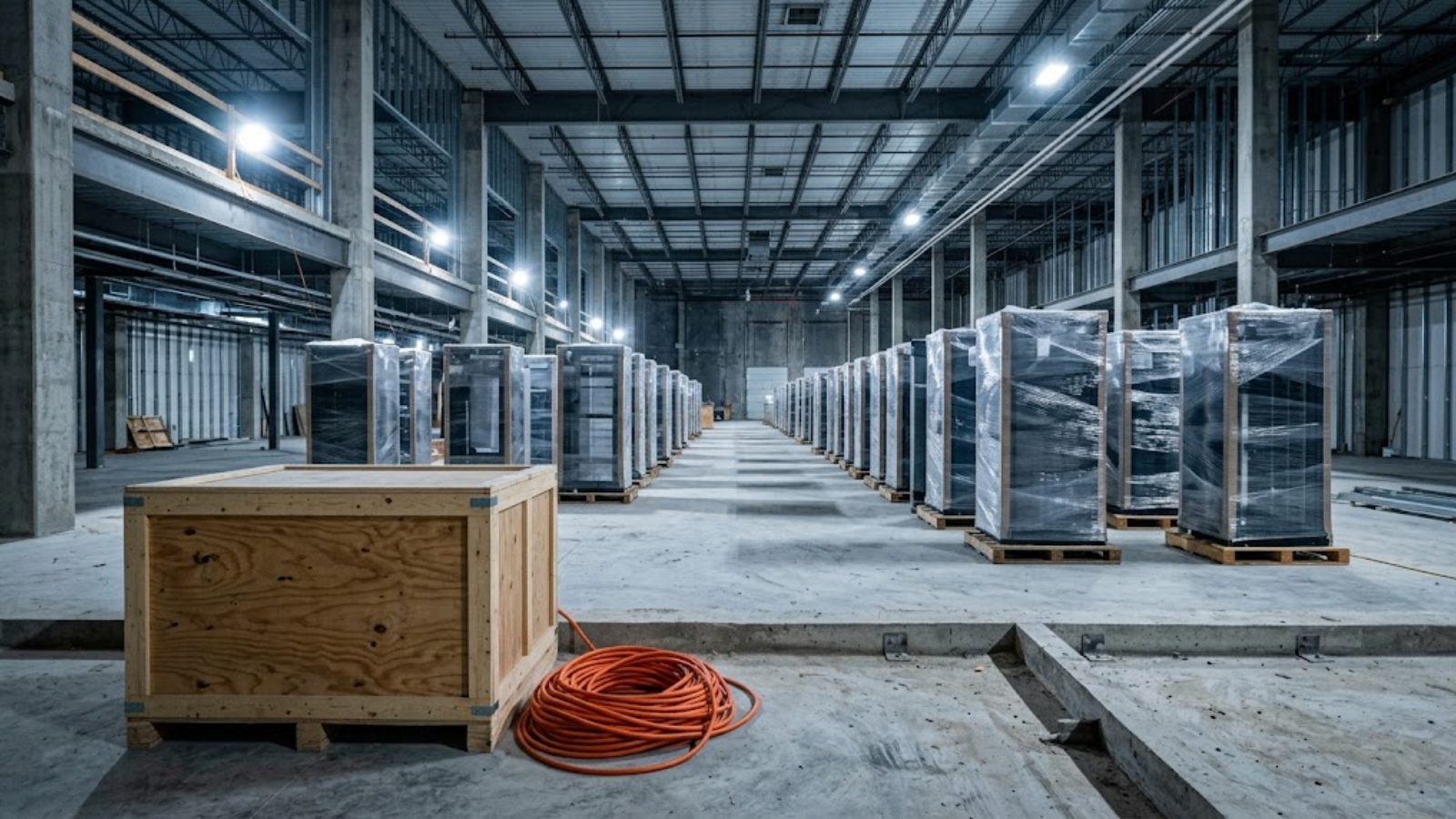
Last week we wrote about Nvidia promising its suppliers $279 billion. This week the Journal filled in the rest of the circle. Nvidia was close to guaranteeing a data-center project expected to cost more than $500 billion when its chief financial officer, Colette Kress, pushed for something smaller after a bad market reaction. The backstop landed at $105 billion — still the largest financial guarantee any chip company has ever made — in exchange for the exclusive right to supply the first half of the site.
Then Kress went on the earnings call and, instead of playing it down, listed the rest: a $500 billion financing initiative with six Wall Street firms for chip purchases, “selective credit enhancement” so an unnamed AI lab can buy two gigawatts of computing, credit support for smaller cloud companies that share revenue with Nvidia, and nearly $50 billion invested in frontier labs. “We know some will call this circular financing,” she said. “We see it differently.” The stock rose 8.7% that day. Jensen Huang, asked directly on X whether it was circular financing, answered: “No.”
Three deals, one balance sheet
| This week’s additions | What Nvidia is doing |
|---|---|
| Anthropic–Lambda, $35 billion | Lambda, an Nvidia-backed cloud, rents Anthropic capacity in a Texas data center that Nvidia itself leases from bitcoin miner Hut 8 |
| SB Energy IPO, as soon as September | Nvidia committed $3 billion across two private deals, one at a 10% discount to the offering price; the Ohio project’s financing depends on Nvidia’s residual-value guarantee |
| OpenAI warrants in SB Energy | Valued at $5.5 billion, up from $3.6 billion in January; SB Energy in turn must buy $50 million of OpenAI software |
SB Energy, majority-owned by SoftBank, wants to raise $5 billion to $7 billion. Its draft filing shows $140 million of revenue in the first half — from solar and batteries, not data centers — a $3.2 billion net loss driven by the rising value of the warrants it gave OpenAI, 800 megawatts under construction and a contracted backlog above $400 billion. It warns that it is substantially dependent on OpenAI. OpenAI, SoftBank and Nvidia are also its investors. Everyone at the table is holding everyone else’s paper.
What the old-timers said in Maine
Hannah Erin Lang went to Camp Kotok, the invitation-only fishing retreat where money managers say what they will not put in a client note. A tech investor was explaining chip design a molecule at a time when a hand went up: all of this costs trillions — will there be a return? “I can’t answer the question, and Wall Street can’t answer the question. I don’t know that yet. I worry about that.” Over poker one camper argued data centers are overbuilt; another said every real technology — railroads, the internet — was overbuilt first. Some have trimmed big-cap tech to neutral. Nobody is short. “Nobody wants to be left behind,” the investor said afterward. “And when the music stops, someone’s going to be holding the bag.”
Anil Gupta, in the Tuesday paper, gave the uncomfortable answer to the camper’s question: firm-level return on AI may be “maybe never,” because when every insurer cuts a claim’s cost 30%, competition hands the gain to customers. The technology is real; the profits get competed away. That is a different risk from a bubble, and it argues for owning the companies collecting the tolls — the chips, the power, the cooling — rather than the ones hoping to keep the productivity.