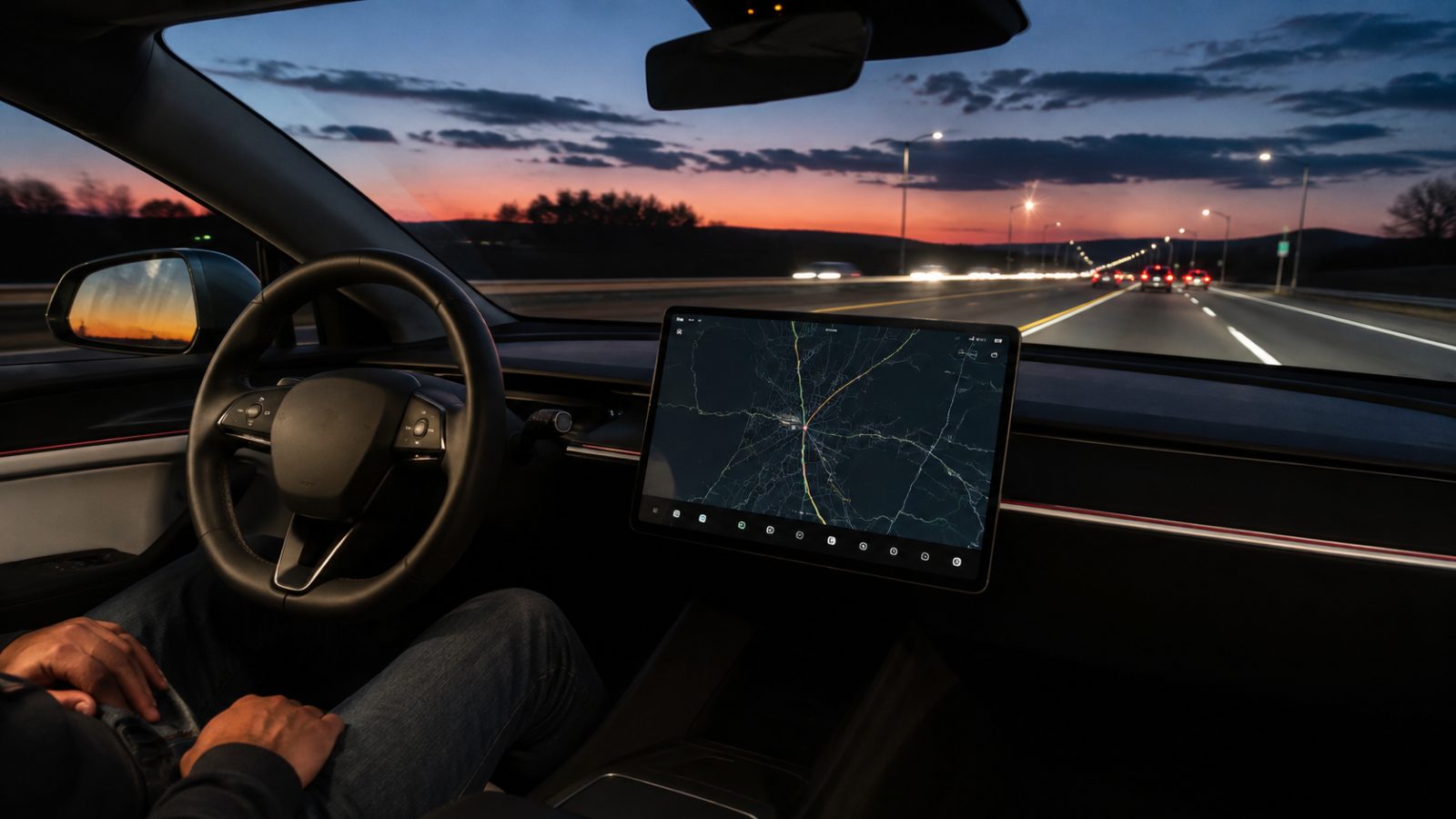
Dan Neil Let the New Model Y Drive Him Around Charlotte. Then Tesla Made the Best Part $99 a Month.
The 2026 Model Y is cheaper, lighter and smarter than the car Neil once called the best in the world — and BMW’s new iX3 goes 140 miles farther on a charge. Without Full Self-Driving, he says, it would not keep its lead. Tesla just made FSD a subscription.
By Sean Anees Saifi · Capital Wealth · Published Tuesday, September 1, 2026 · Source: The Wall Street Journal, August 29–30 and September 1, 2026 editions
Key Points
Model Y Premium RWD: $45,490 base, several thousand below the first generation; 295 hp, 357-mile EPA range, 0–60 in 5.4 seconds, 4,184 pounds.
BMW’s iX3 claims up to 434 miles and an 800-volt system; the Model Y keeps 400 volts and tops out at 250 kW charging while networks run 350.
FSD version 14 offers five modes — Sloth, Chill, Standard, Hurry and Mad Max. In Hurry it swept past traffic “as if I were late for my wedding.”
After two hours in rush-hour Charlotte: “FSD drives at least as well as Coach Vestal, my high-school driver’s ed teacher.” He was “bewitched.”
Tesla now offers the latest FSD only by subscription at $99 a month: “Tesla just made the best thing about the Model Y optional.”
$45,490
Model Y Premium RWD, base
357 mi
EPA range; BMW iX3 claims 434
$99/mo
Full Self-Driving, subscription only
5.4 s
0–60 mph
No CarPlay, no gear selector, a 16-inch screen and a car that already knows whether you want to go forward or back.
In one line: The car review is a business review: the hardware fell behind, the software stayed magical, and the company just turned the magic into a monthly bill.
Dan Neil waited a year for Tesla to send him a 2026 Model Y and finally rented one on Turo. Six years ago he proclaimed the original the best car in the world and the world agreed — it led global sales of all passenger vehicles from 2023 through 2025. The update is stronger, lighter, smarter and cheaper, starting at $45,490. It also, on the numbers, trails: BMW’s new iX3 claims up to 434 miles of range on an 800-volt system, while the Model Y keeps 400 volts, 357 miles and a 250-kilowatt charging ceiling in a world of 350-kilowatt chargers.
“So while the Model Y is a better machine in many ways… is it enough? My conclusion: Without FSD, it wouldn’t be.”
The ride
He engaged Full Self-Driving by accident in the airport lot; the car understood “Home,” seized the wheel and merged for Interstate 77 toward its owner’s house — “It felt like being kidnapped.” Version 14 offers five modes: Sloth, Chill, Standard, Hurry and Mad Max. In Hurry it passed traffic on both sides. He reset the destination to a golf course, tapped the button and let go. For half an hour he covered the brake at every intersection. Then it earned him: lane centering, following distances, the gradients of braking and steering “all playing out in smoothly continuous linear functions,” an emotional maturity when confronted with what he calls jackass behavior. By hour two he was “bewitched.” He is, he notes, a sample size of one.
2026 Model Y Premium RWD
Price, base / as tested
$45,490 / $49,130
Power / torque
295 hp / 325 lb-ft
Range / 0–60
357 mi EPA / 5.4 s
Full Self-Driving
$99 a month, subscription only
The last paragraph is the business
Tesla buyers used to pay thousands up front for FSD. The newest versions are now available only by subscription at $99 a month. “That doesn’t seem particularly superintelligent,” Neil writes. “Tesla just made the best thing about the Model Y optional.” Read it the other way and it is the entire investment thesis in one sentence: the car is the trial, the software is the product, and the company would rather collect $1,200 a year forever than $8,000 once. That is a better business, if the drivers pay. Tesla is a laggard in the S&P 500 this year, per Heard on the Street, and the Journal notes Chinese regulators are pushing back on screen-only controls. Whether the subscription sticks is the number that matters, not the 0–60.
What It Means For Your Portfolio
Watch — TSLA; the car is the trial, the subscription is the business
Tesla stays a watch in the Capital Wealth books at its existing small weights: the hardware lead has narrowed, the software lead is real, and the company just changed how it gets paid for it. We want to see the subscription numbers before the weight changes.
A $99-a-month software line on a $45,000 car is the auto industry becoming the phone industry. The names that win that transition are the ones whose customers keep paying in month thirteen — that is a churn number, and it is not published yet.
For the household, the lesson is the one Neil ends on: the feature that sold you the car may now be a recurring bill. Read the subscription before you sign for the vehicle, the same way you read the expense ratio before the fund.