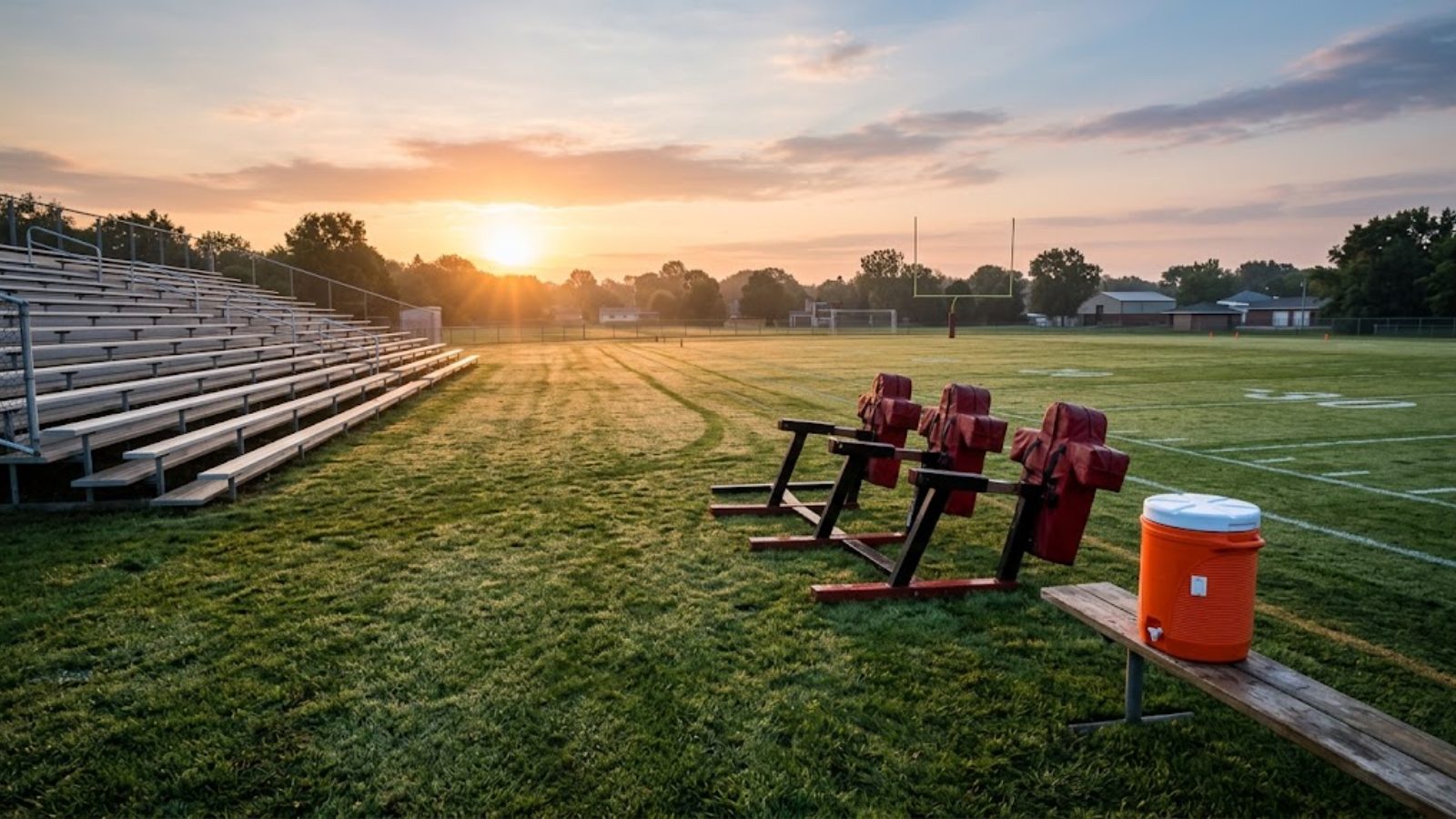
As the Oregon Ducks collapsed into the most shocking upset of the college football season, exactly one man knew what was going wrong. It wasn’t Dan Lanning, the head coach with national-championship aspirations. It wasn’t anyone in his army of assistants. And it wasn’t Dante Moore, the Heisman-candidate quarterback making an estimated $5 million this season who could be the No. 1 pick in next year’s NFL draft.
It was AJ Woodin, a sales manager in Bargersville, Indiana, sitting on his sofa about 700 miles from Stillwater, Oklahoma.
What he saw
Woodin noticed a tell in Moore’s stance as he waited on the snap. Any time the Ducks were about to pass, Moore’s right foot was about a foot behind his left. When he was preparing to hand off, his feet inched closer together.
“Watch this,” Woodin told his wife, Beth, during one Oregon drive. “This is gonna be a run.” It was. The next play he guaranteed a pass, and moments later Moore dropped back to throw.
“By the end of the game,” Woodin said, “she was predicting every play.”
A minor difference in foot placement, visible on a television screen from several states away, in the stance of one of the best passers in the country. Catastrophic.
Why he could see it
Woodin spent four seasons as a backup at Idaho, which he describes as mostly holding a clipboard. What he actually got was an education. His coach, Paul Petrino, was a quarterback guru with a singular obsession: reading opponents like poker players.
“If a quarterback licks his hands before he throws, or wipes his towel before he hands off — these were all things we were analyzing,” Woodin said.
And — this is the part that matters — Petrino also drilled his own players to eliminate any tells that might give a defense information for free. Woodin was trained to look in both directions.
His suspicion started earlier. Watching Oregon’s playoff run end in a 34-point blowout loss to Indiana last January, which began with an interception on the first play from scrimmage, something didn’t sit right. “It seemed too easy,” he said. “What defensive back would jump that route in a playoff game, with reckless abandon? It just didn’t make sense.”
So he investigated. On Monday morning he messaged a friend who runs a blog about West Coast football, and by the afternoon — while fans were still trying to make sense of the loss — the explanation was spreading across social media.
Moore, to his considerable credit, owned it: “It just shows me as a player that I have things that I need to fix. I got to make sure I don’t show it to a defense.”
The idea underneath
The Journal puts the general principle in one line: although college programs dedicate countless man-hours to cracking any secret in their opponents’ plans, turning the magnifying glass toward their own habits is a far greater challenge.
That is not a football observation. It is a description of nearly every organization and nearly every household.
The effort goes outward. Investors research funds, compare fees, read forecasts, study markets — all of it pointed at the external world. Almost nobody audits their own repeated behavior: what they actually did in the last three selloffs, whether they always sell after a certain amount of pain, whether they have bought the same kind of story three times, whether the spending always rises to meet the raise.
Those patterns are as legible as a quarterback’s feet, and they are visible in a document most people already have: the account statement. The transaction history is the film.
Nobody sees their own tells. That is what makes them tells. It usually takes someone who has watched a lot of film — and fifteen minutes with the record of what you actually did, rather than the story of what you meant to do.