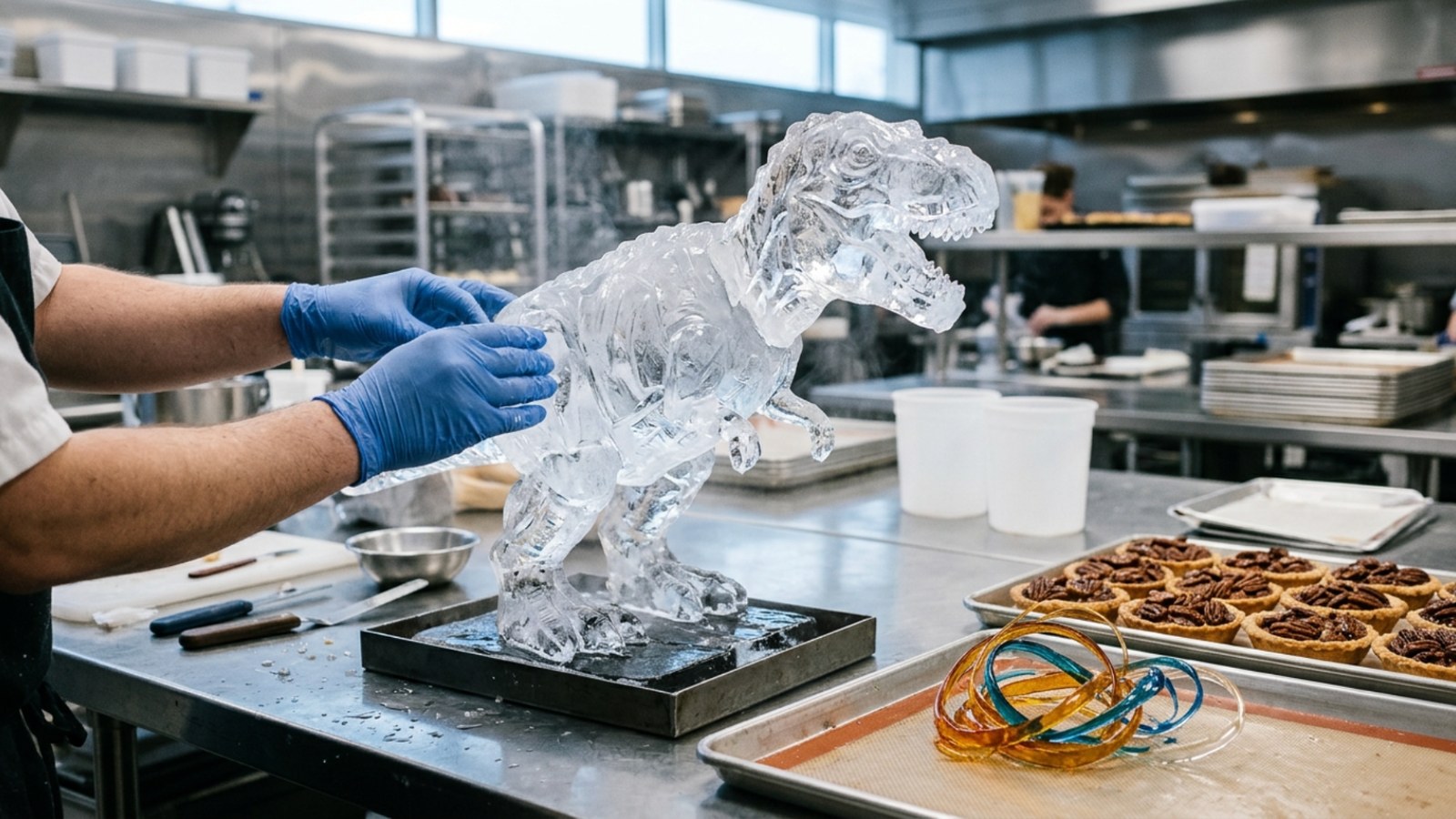
The raptor's head broke off on stage. It stood 30 inches tall, and Nicholas Forte had carved it from ice. A live crowd watched him. A giant screen counted down the seconds. He fixed it. Within hours his team had the gold medal.
Forte is one of four chefs on Pastry World Cup Team USA. Nora Knoepflmacher tells their story on the front of the Journal's Off Duty section. The gold came at the Americas Selection in New Orleans. It earned the team a spot at the World Final in Lyon, France, in January. The dinosaur display also had a triceratops made of hardened sugar and a pecan pie shaped like a fossil shell. The trouble was the ice. It was too warm to bond. Forte patched the raptor, and the other chefs kept building around him.
Unpaid, with day jobs
Nobody on the U.S. team gets paid. The chefs hold full-time jobs and travel to Chicago to train on weekends. Their test kitchen has a chain saw, a chocolate spray gun and a 2,400-pound pallet of ice. It also holds 500 pounds of dark chocolate. Forte practices ice carving in a freezer warehouse on weekends before work. The prize money is around $26,000 for the winning team. The Journal says the chefs care more about being champions. Team captain Jordan Snider, 41, said, "It is the highest honor."
In Lyon they'll face 18 other teams in front of thousands of people. Each team gets nine hours to make three desserts and three showpieces in ice, sugar and chocolate. Japan has won the last two golds. France has the home crowd. The last American title came in 2001. So the team runs the whole nine-hour program again and again. The alternate, Sarah Helzer, moves from station to station and fills pages with notes. She learns every teammate's job so she can step in after an injury. Her tip for home bakers fits the theme. If a cake fails, don't start over. Crumble it, layer it with jam or pudding, and call it a trifle.
Our read
This is a Career and Behavioral story, and the part we like best is how the team trains. They don't run the hard parts once. They run the whole nine hours, over and over. An alternate learns every job in case of an emergency. So when the head fell off, Forte had a repair to make, and he made it. En-Ming Hsu captained the 2001 winners and now helps run the team. She told the Journal, "If you have a bad day, you're not going to win the game." Most money plans skip the bad day. We draw them for the good years.
Here's where it touches your money. Your plan has a raptor's head too. For a working family, it's the month a paycheck stops and the emergency fund has to carry the bills. For a new retiree, it's a year when stocks fall right after the last day of work. This week, pick your one bad day and write down three things. Write which account you'd draw from first. Write which bill you'd cut. Write who steps in if you can't, and whether that person knows where the papers are. Bring that page to your next review. A repair goes faster when you've practiced it before the break. These are general planning principles, not advice.