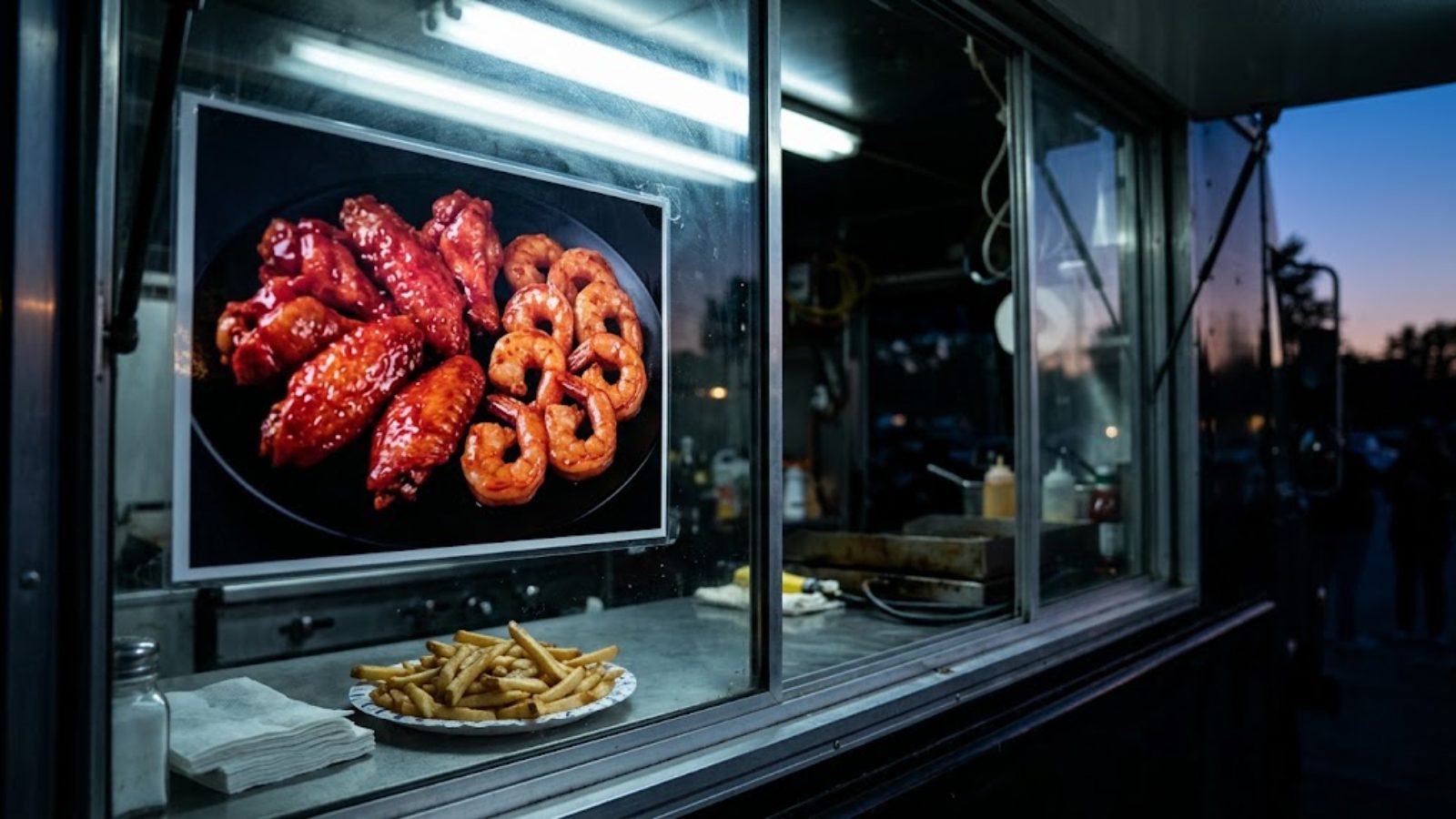
Janely Montgomery just wanted lunch. At a carnival near Buffalo, N.Y., she wandered up to a halal truck, and the pictures on its side gave her a full Twilight Zone moment: she knew every dish by name, and every image was a little off. The shawarma looked like a tortilla rolled around chickpeas and stamped all over with circles. “It just looks like what I assume an alien would think that we eat,” she told the Journal. No aliens were involved; an image generator was.
Restaurants reach for AI pictures as a stopgap while commissioned photos are pending, or as a cheaper substitute for professional marketing, and they’re appearing on everything from to-go menus to deli cases. They do get noticed — just not in the appetizing way. Social media is passing around salads of unnatural symmetry, noodles with a lacquered gleam, shrimp shaped like life preservers and chicken wearing dinosaur hide; one poster on X decided a plate of wings had been fished out of a reactor core. In Washington, a 36-year-old paralegal ticked off the tells: fries that repeat like wallpaper, bread with more texture than bread has any right to.
Why does this keep happening? Jory Schossau, an AI researcher, says the generators are pattern predictors: when a dish’s nuance escapes them, they fall back on rules of thumb — cooked shrimp are roughly round, with bands — and out come shrimp that look like rubber rings from another planet. Sometimes they repeat a texture so perfectly it sets off trypophobia, the skin-crawl some people get from clusters of holes. Here’s the odd part: better tools exist. Schossau asked Google’s (GOOGL) Nano Banana for mac-n-cheese and shrimp scampi and got believable results, and he suspects many of the viral horrors came from older models.
The sign came down
It can backfire fast. Lyndsey Lozano opened a San Francisco cafe with her husband this year and used AI ads for its sandwiches and iced drinks; the internet shredded them, someone vandalized the storefront with graffiti, and the sign came down — in a city she calls tech-forward, no less. Across the country, Jordan Beau of Daisy’s Diner & Bar in Brooklyn isn’t apologizing: AI, he says, stretches his marketing budget and pulls in younger customers. His ads start from photos of real food, even if his TikToks feature ube pancakes under a purple sauce that seems to pulse and a bartender with three hands.
Our read
A menu photo is a promise, and the uncanny ones break it in public — ask the San Francisco cafe whose sign came down. That’s the consumer-protection lesson hiding in the shrimp (M11). The glowing wings are the easy fakes; Schossau’s test suggests newer tools already make believable food, which means the fakes that cost people money may not look radioactive at all — the rental listing, the car for sale, the contractor’s past work. So don’t grade the photo; verify the thing before money moves — see it, call a number you looked up yourself, and never wire a deposit on the strength of a picture.
Investing has its own menu photos: the glossy brochure, the pitch deck, the chart that only goes up. The holdings list and the fee table are the food. Taste those first.