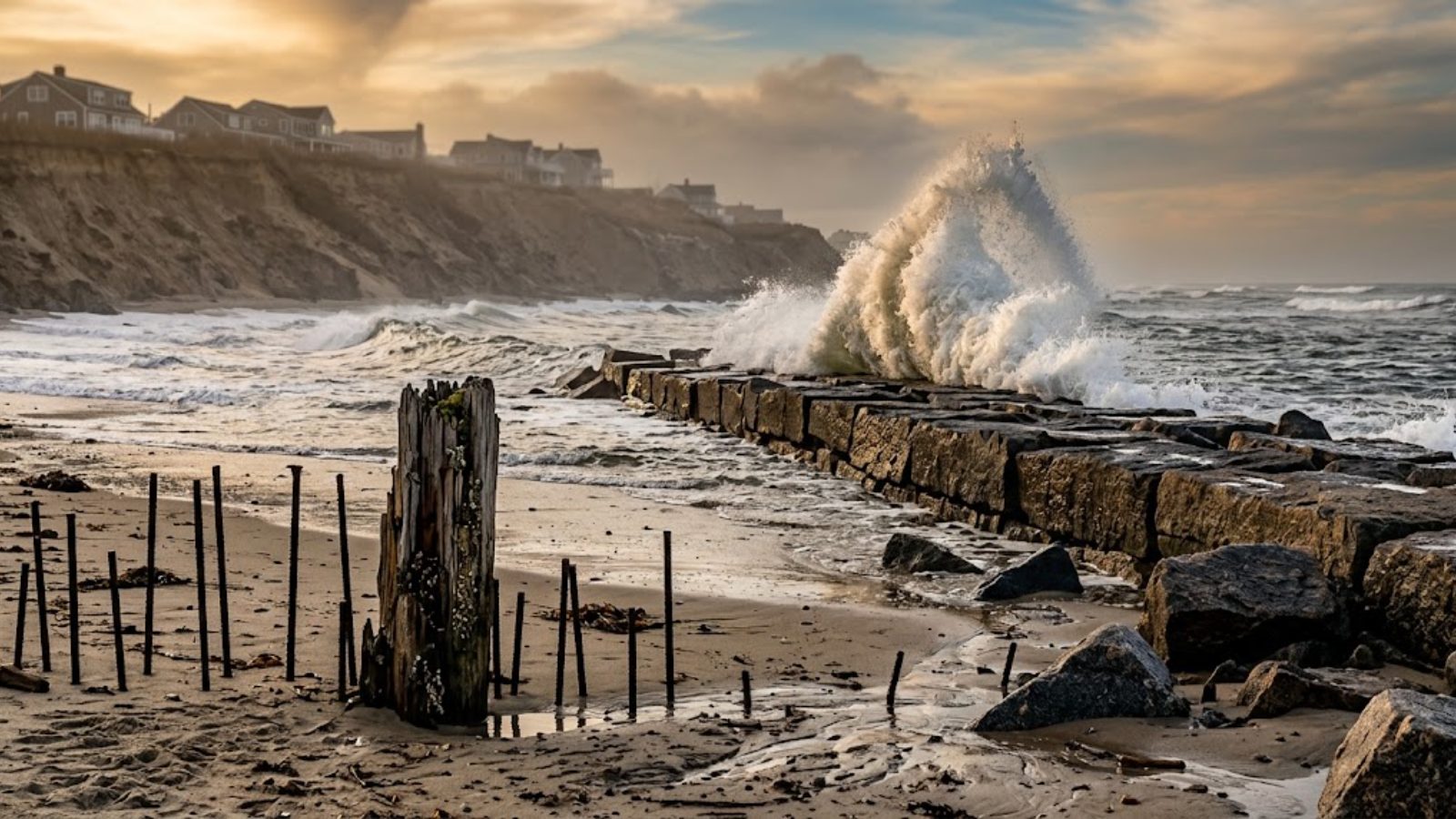
El Niño Gave the Wedge Some of Its Best Waves in Memory — and Uncovered Rebar Buried a Century Ago
Newport Beach’s notorious Wedge is serving some of the best surf anyone can remember, and the sand that hid a century-old junkyard of rebar, pilings and rock has washed away. Meanwhile, a six-foot sand cliff creeps toward $20 million homes.
By Sean Anees Saifi · Capital Wealth · Published Friday, September 25, 2026 · Source: The Wall Street Journal, Wednesday, September 23, 2026 edition, whose market figures are the Tuesday, September 22 close, and the Friday, September 25 edition
Key Points
A super El Niño and a relentless run of swells have carried off truckloads of sand along the California coast, and at the Wedge — Southern California’s most dangerous surf break — debris buried for about a century is back in play: boulders, jagged wooden pilings, rods, pipes, wires and rusty metal.
The Wedge is man-made: in the 1930s the Army Corps of Engineers pushed a rock jetty roughly 2,000 feet out to shield the mouth of Newport Harbor, and swells glancing off its angle stack into triangular peaks that can reach two or three times their original height, breaking a few yards from the sand.
The Encyclopedia of Surfing says no surf break outside Hawaii has injured more riders, estimating eight deaths, dozens paralyzed and thousands hospitalized — and that was before the debris surfaced.
A longtime bodysurfer, 69, reckons about two-thirds of the beach’s width has washed away this year, with roughly 50 yards of sand left in front of the nearest houses; El Niño’s winds can temporarily lift local sea levels six to 12 inches, a UC Irvine sand researcher says.
Along the coast in recent weeks: a damaged sea wall in Long Beach and wrecked beach stairs in San Diego County, plus dozens of waterfront mansions declared unsafe. On Aug. 25, Newport Beach’s city council agreed unanimously to look into the erosion.
2/3
of the beach’s width gone this year, by one local’s count
~50 yds
of sand left in front of the nearest houses
$20M
oceanfront homes the sand cliff is creeping toward
6–12 in.
temporary sea-level rise from El Niño’s wind patterns
Locals used to know exactly which exposed rock was the Matterhorn. Now there are too many to pick from.
In one line: The same swells and super El Niño giving the Wedge some of its best waves in memory are carrying off the sand that stood between the ocean and $20 million homes — coastal ground is a moving number, and this year it’s moving fast.
Ronan Collins has a plan for the rusty spikes, and it fits on a surfboard. The 21-year-old waxes his board up on a six-foot sand cliff in Newport Beach, Calif., paddles into some of the best surf anyone there can remember, and tries not to imagine being impaled on hundred-year-old rebar. His method, as he told the Journal: “Good thoughts and good vibes.” The cliff he’s standing on, meanwhile, is creeping toward oceanfront homes worth $20 million.
The Wedge is a wave people built by accident. In the 1930s the Army Corps of Engineers ran a rock jetty about 2,000 feet out to guard the mouth of Newport Harbor; it sits at a slight angle, so south swells ricochet off it into triangular peaks — hence the name — that can grow two or three times taller before slamming down a few yards from the sand. The Encyclopedia of Surfing says no break outside Hawaii has hurt more riders: an estimated eight dead, dozens paralyzed, thousands hospitalized. A Jackass Forever cast member told the paper it’s known for snapping necks. He’d driven an hour from Oceanside to ride it anyway.
This year the sand left and the basement came up. El Niño warms the eastern Pacific and feeds the hurricanes that fling big swells at south-facing beaches — that’s the fun part — but according to Brett Sanders, a UC Irvine professor who studies sand, it also shifts winds enough to lift local sea levels six to 12 inches for a while. Add a steady run of swells pushed up by New Zealand storms, and the beaches are getting scoured. What’s surfacing: boulders, rods, pipes, wires and jagged pilings, some of it from the city’s failed jetty attempts of the early 1900s, local historian William Lobdell says. A 53-year-old self-styled Wedgelord says this summer has topped the fabled El Niño summer of 1982.
Fifty yards of beach
On land, the math is less fun. Kevin Thoman, a 69-year-old Wedge bodysurfer, reckons about two-thirds of the beach’s width has washed away this year, leaving roughly 50 yards of sand in front of the nearest houses. Recent weeks brought a damaged sea wall in Long Beach and wrecked beach stairs in San Diego County, plus dozens of waterfront mansions declared unsafe; on Aug. 25 the city council agreed, unanimously, to look into it. And Friday’s paper notes the world is living through an El Niño stronger than any in decades.
Our read
On Monday we wrote about Citadel’s Miami tower and the limestone it has to build on. This is the California sequel, and the moral’s the same, only faster — the ground under coastal property isn’t a constant (M6). The sand in front of a beach house is its first line of defense, and it doesn’t appear on the listing. So price the ground before the view — the flood zone, the elevation, the shoreline’s erosion history — and get the insurance quote in writing, or the written no. Standard homeowners policies generally exclude flood, which needs its own policy, and gradual erosion usually isn’t covered by either, so ask in writing what happens if the ground itself leaves (M11).
And read a council’s vote to study the problem for what it is: the first step of a long process, not a sea wall. Good vibes are a perfectly respectable surf philosophy. As a coastal property plan, they’re a little thin.
What It Means For Your Portfolio
Hold — price the ground before the view
No portfolio action — the risk in this story sits under the house, not in the brokerage account: coastal ground moves, and this year’s super El Niño is moving it faster than any listing photo shows.
General planning principles, not advice for anyone in particular. Before buying near the water, collect the flood zone, the elevation certificate if there is one, any shoreline or geologic report and a written insurance quote before you fall for the view. Flood usually takes a separate policy, and gradual erosion generally isn’t covered by homeowners or flood insurance, so get the insurer’s answer in writing rather than assuming it.
Owners already on the coast should size a repair reserve for the setting, not for a national rule of thumb, and treat a city study as the opening of a long process. A plan that only works if the sand comes back isn’t a plan; it’s a surf forecast.